

Deep Heritage as a platform for the Unity of Humanity
The paper was written for the International Conference RETHINKING TRADITIONS, Shifting perspectives in Cultural Inerpretation, organized by Guru Ghasidas Vishwavidyalaya (central University in Bilarpur, India) in collaboration with International Centre for Cultural Studies.
3/5/20262 min branje
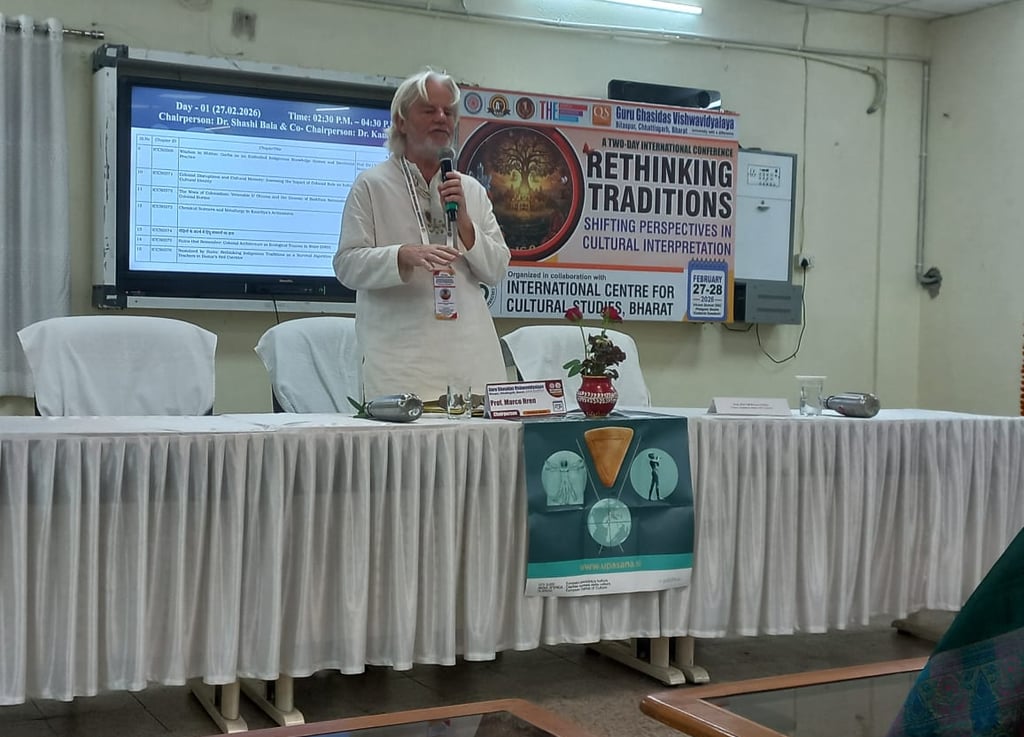
The paper was presented at the Plenary session for Theme – I I: Epistemic Authority and Ancient Knowledge: Reevaluating Validity and Voices on February 27, 2026.
In addition, UPASANA's chief elder was entrusted to Chair a session on 27. February on Ancient Art Forms and Aesthetics: Methods and Interpretation. UPASANA presented the program on Autochthone Heritage, which was a part of Regular Program of the European Cultural Capital GO!2025.
Key messages passed to the conference:
Before Europe Colonised and Christianised the world, it profoundly and ruthlessly colonised and converted into Christianity the nations on its own territory. Colonisation involved religious domination (christianisation) as its integral and in terms of education, crucial part.
Slovenia was given as an example of thoroughly colonised Slavic country, which suffered fundamental loss of its genuine traditions, ancient wisdom, including the handicapping of its language, loss of cosmological terms which were converted by Jesuit and other Christian literates into its opposites to disable true understanding of language. Places of worship in nature were colonised by erecting of Christian churches and chapels. Spiritual leadership of authentic faith was pushed into clandestine activity. Decision makers, institutions including cultural institutions prove that Slovene knowledge system remains profoundly colonised until today: an example of the campaign at Bled Island, former Slavic nature centered shrine and worship place, was presented as contemporary sad proof of colonised slovene politics of knowledge. Political elite remains silent while Church established a biased – post colonial museum at the island under auspices of Slovene national museum. Even though we failed to prevent this neocolonial reflex, we see a positive side in the story: now we have gained an undisputable proof of existence of profound colonised knowledge and politics in Slovenia. Sad, however true.
Fight against neocolonial practices in science, art, culture and education shall therefore not only mobilise the former colonies outside Europe, but primarily the nations in Europe, formerly nations of Druid, Celtish, Nordic, Slavic and other pagan, heathen, people of the earth.
The paper explains how UPASANA and nature centered elders strive to reconstruct the traditions and integrate ancient knowledge in knowledge corpus. Through interdisciplinary events (seminars, conferences, cultural events), we involve artists, scientists, independent researchers and practitioners.
Full text, published in the conference proceedings, is published here.